 Villa Mon Étoile
Le Touquet architecture: villas, styles, architects and buildings to see
In short
Le Touquet's architecture mixes Anglo-Norman, regionalist and Art Deco villas, built mostly between 1900 and 1939 in the forest and around the centre. Its leading names are Louis Quételart (Canche lighthouse, villas Pomme d'Api and Les Mutins), Louis Debrouwer and Pierre Drobecq (town hall, 1931), Henri-Léon Bloch (covered market, Villa Way Side) and Horace Pouillet (Villa Tata Ice). Around twenty buildings are protected as historic monuments.
In Le Touquet, architecture is best discovered on foot, looking up. The resort was built very quickly, between the late 19th century and the 1930s, for a well-off and often English clientele: half-timbered villas, turreted chalets, Art Deco façades and grand public buildings in brick and stone. Around twenty buildings, villas included, are protected as historic monuments. Here is how to recognise the styles, who the architects were and which buildings not to miss.
A town designed on the dunes
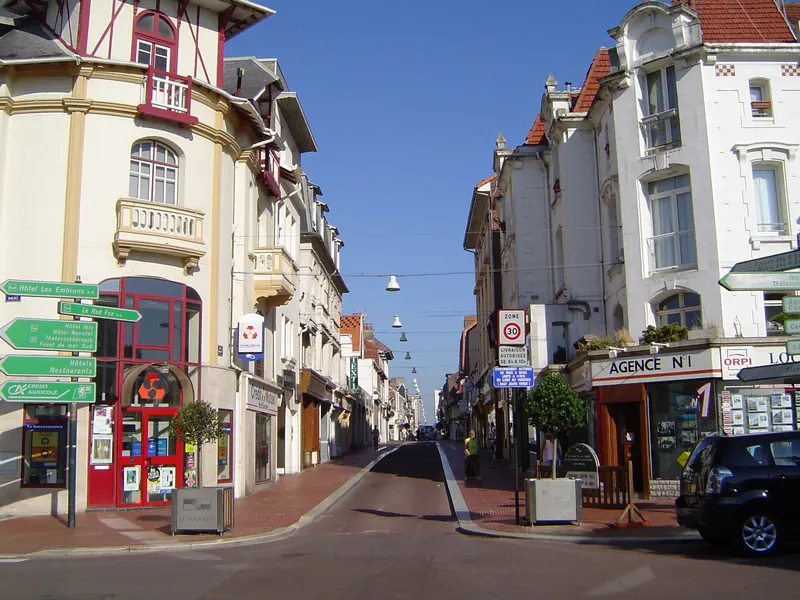
Before the villas came a plan. The first Paris-Plage estate, inaugurated in 1882, was designed by Raymond Lens: a grid of streets running perpendicular to the sea, around today's rue Saint-Jean. After John Whitley bought the estate in 1902, the land east of boulevard Daloz was laid out to a design by Joseph-Louis Sanguet, with gently curving roads reaching into the pine forest. Both faces are still visible today: a dense, shop-lined grid in the centre, and wooded districts where villas hide behind the trees.
The streets in the centre are named after capitals and major cities (rue de Paris, de Londres, de Moscou, de Metz), a nod to the cosmopolitan clientele the resort hoped to attract.
Le Touquet's architectural styles
Four main families sit side by side in the streets:
- Anglo-Norman: half-timbering, very steep roofs, gables, often brick and stone. This is the style of Villa Way Side (the museum) and many of the houses in the forest.
- Regionalist and picturesque: local stone, turrets and miniature-château silhouettes, such as Le Castel (1904) or the Village Suisse.
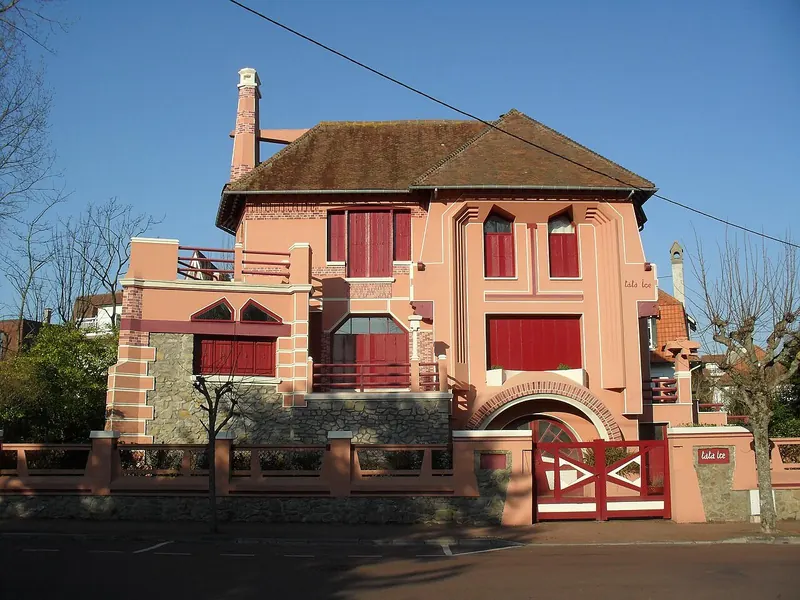
- Art Deco: geometric volumes, concrete and bold colours, in the 1920s and 1930s. The most striking example is Villa Tata Ice.
- Post-war modern: reconstruction-era buildings and seafront residences from the 1960s onwards.
Almost every villa has a name (Pomme d'Api, Les Mutins, Le Quart-d'Heure…) and often a plaque bearing the architect's name. It's worth looking for one near the entrance.
And after 1945?
Reconstruction and the 1960s transformed the seafront: the Dolce Vita residence (1961), by Jacques Bouchardy and Philippe Faure, was the first high-rise, and the hotel school replaced the Royal Picardy, demolished in 1968. This contrast between old villas and modern blocks is part of the Le Touquet landscape.
Le Touquet's architects
Louis Quételart (1888-1950)
Born in Berck and trained on the job in local practices without a formal diploma, Louis Quételart is the architect most closely associated with the resort. His first villa, Fadette, dates from 1912. He went on to design dozens of villas (Pomme d'Api in 1923, Les Mutins in 1925, Bic en Coin in 1926, Pretty Cottage in 1928), the Le Normandy cinema and the 1936 airport terminal. Finally he designed the Canche lighthouse, completed after his death by his son Pierre. Several of his villas are listed as historic monuments.
Other notable names
- Louis Debrouwer and Pierre Drobecq: the town hall (1931) and the Royal Picardy, a 500-room palace hotel that no longer exists.
- Henri-Léon Bloch: the covered market, with Henri-Paul Nénot, and Villa Way Side.
- Horace Pouillet, an architect from Lille: villas Tata Ice (1926), Glenwood and Karidja (1927).
- Henri Valette, from Berck: the neo-medieval Villa Le Castel (1904).
- Anatole Bienaimé, from Amiens: villas Monéjan and Le Roi d'Ys.
- Paul Bertrand: the Village Suisse (1905-1906), avenue Saint-Jean.
- Lucien Viraut: the Sainte-Jeanne-d'Arc church (1910-1911).
Buildings not to miss
| Building | Date | Architect(s) | Protection |
|---|---|---|---|
| Canche lighthouse | 1949-1951 | Louis Quételart | Listed (classé MH) |
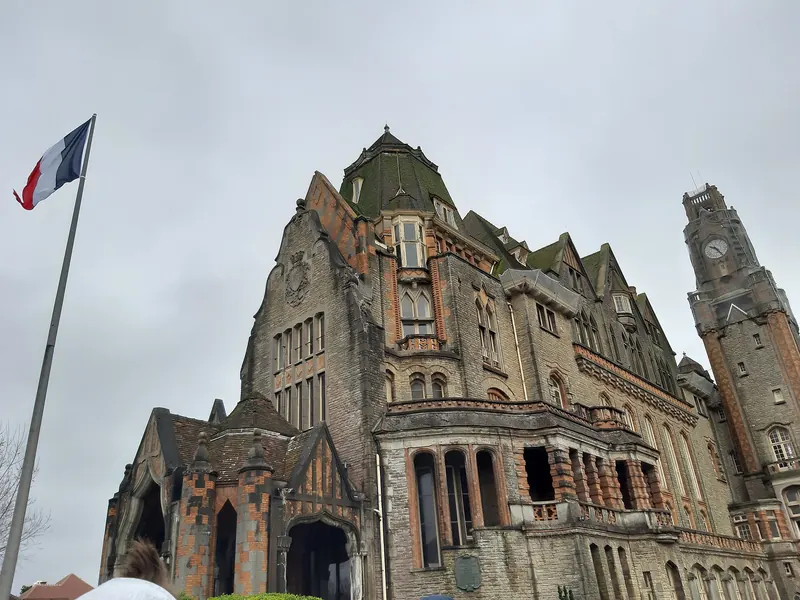
| Town hall | 1931 | Louis Debrouwer, Pierre Drobecq | Listed (classé MH) |
| Covered market | 1931-1932 | Henri-Léon Bloch, Henri-Paul Nénot | Registered (inscrit MH) |
| Post office, rue de Metz | 1920s | — | Registered (inscrit MH) |
| Sainte-Jeanne-d'Arc church | 1911, rebuilt 1950-1955 | Lucien Viraut | — |
| Villa Way Side (museum) | 1920s | Henri-Léon Bloch | — |
| Westminster hotel | 1924 | — | — |
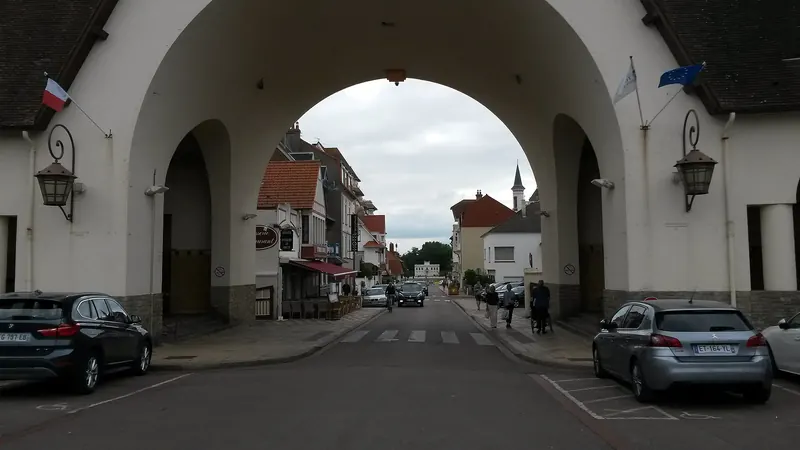
The town hall is the most spectacular: a blend of English Gothic, timber framing and Artois gables, in Baincthun and Hydrequent stone, beneath a 38 m belfry whose carillon plays the Big Ben chime. Right next door, the covered market forms a semicircle around a square, with a large arch spanning rue Jean-Monnet. The brick lighthouse is 57 m tall.
Remarkable villas to look out for
The villas are private homes: admire them from the street without entering the gardens. Among those listed as historic monuments:
- Tata Ice (1926), avenue de la Paix: a pink façade that suggests a face, somewhere between Art Deco and Czech Cubism.
- Le Castel (1904), 50 rue Jean-Monnet: a turret and the air of a small château.
- Pomme d'Api (1923), rue de Moscou: Quételart's first combined home and studio.
- Les Mutins (1925), boulevard Daloz: his home and studio from 1925.
- Glenwood and Karidja, avenue de la Reine-Victoria: two villas by Pouillet.
- Saint-Augustin, Thalassa, Phébus and Borée: a cluster of four late-19th-century family houses on the seafront.
You'll find them mainly in the area bounded by rue Saint-Jean, boulevard Daloz and the town hall, and in the forest around avenue du Golf and avenue du Château.
A walking tour of about two hours
- Start at the foot of the Canche lighthouse, allée des Mésanges.
- Head to the Westminster hotel, avenue du Verger, and its brick façade.
- Walk down avenue Saint-Jean to the Village Suisse and Villa Monéjan.
- Turn towards avenue de la Paix and Villa Tata Ice.
- Continue to the town hall, the church and the Jardin d'Ypres.
- Follow rue Jean-Monnet: Le Castel, then the covered market.
- Finish facing the sea on place du Centenaire, in front of Alain Godon's Tour Paris-Plage (2017), a 9.5 m Eiffel Tower.
The forest villas, more spread out, are best explored by bike: the tourist office even runs a guided bike tour dedicated to them. Allow for a loop via avenue du Golf and avenue du Château, with a stop at the Villa Way Side museum, whose reception rooms have kept their original wood panelling.
Charles's tip: do this walk out of season or early in the morning, when the trees have fewer leaves and the streets are quiet: the façades are much easier to see. And book at least one guided tour with the tourist office, especially the town hall tour, which opens rooms that are otherwise inaccessible.
Stay in a 1920 villa
Villa Mon Étoile, on rue d'Étaples, is itself a 1920 house with Art Deco touches, a few minutes' walk from the town hall and the covered market. It houses two apartments, Hélios and Cassiopée, ideal for exploring the resort on foot. To go further, read our history of Le Touquet, our selection of places to visit and the walk through the iconic streets.
Frequently asked questions
What is Le Touquet's architectural style?
There isn't just one: you'll find half-timbered Anglo-Norman villas, turreted regionalist villas, Art Deco façades from the 1920s and 1930s and modern apartment blocks on the seafront.
Who designed the Le Touquet lighthouse?
Louis Quételart. The 57 m Canche lighthouse was built from 1949 and completed after his death in 1950 by his son Pierre.
Who built Le Touquet's town hall?
The architects Louis Debrouwer and Pierre Drobecq, in 1931. The building and its 38 m belfry are listed as a historic monument.
Can you visit the villas in Le Touquet?
Most are private homes, to be admired from the street. Villa Way Side, which houses the museum, is open to visitors, and the tourist office runs guided tours of the villas, including by bike.
Sources and fact-checking
- letouquet.com/le-touquet-paris-plage/paradis-de-la-culture-et-du-patrimoine/le-t
- letouquet.com/le-touquet-paris-plage/paradis-de-la-culture-et-du-patrimoine/art-
- fr.wikipedia.org/wiki/Louis_Qu%C3%A9telart
- fr.wikipedia.org/wiki/H%C3%B4tel_de_ville_du_Touquet-Paris-Plage
- fr.wikipedia.org/wiki/March%C3%A9_couvert_du_Touquet-Paris-Plage
- fr.wikipedia.org/wiki/Liste_des_monuments_historiques_du_Touquet-Paris-Plage
- fr.wikipedia.org/wiki/Villa_Tata_Ice
- fr.wikipedia.org/wiki/Villa_Le_Castel
- fr.wikipedia.org/wiki/Phare_du_Touquet
- pss-archi.eu/immeubles/FR-62826-79658.html
Stay in the heart of Le Touquet
To enjoy everything described here on foot, stay at Villa Mon Étoile: two 55 m² apartments in an Art Deco villa, 300 m from the beach, from €140 per night.